Showing posts with label economy. Show all posts

Saturday, February 04, 2012

Excerpts of "The Black Book of Communism"


Pertinent quotes from the best-selling book 
[by several European academics and edited by Stéphane Courtois]

“To be sure, the [communistic] model was applied differently in different cultural settings. As Margolin points out, the chief agent of repression in Russia was a specially created political police, the Cheka-GPU-NKVD-KGB, while in China it was the People's Liberation Army, and in Cambodia it was gun-toting adolescents from the countryside: thus popular ideological mobilization went deeper in Asia than in Russia.

Still, everywhere the aim was to repress "enemies of the people" — "like noxious insects," as Lenin said early on, thus inaugurating Communism's "animalization" of its adversaries. Moreover, the line of inheritance from Stalin, to Mao, to Ho, to  Kim II Sung, to Pol Pot was quite clear, with each new leader receiving both material aid and ideological inspiration from his predecessor.

[Editor Stéphane Courtois asserts that "...Communist regimes...turned mass crime into a full-blown system of government". He cites a death toll which totals 94 million, not counting the "excess deaths"

(decrease of the population due to lower than-expected birth rates). Deaths given by Courtois is as follows]

It is not always easy to distinguish between events caused by fighting between rulers and rebels and events that can properly be described only as a massacre of the civilian population. Nonetheless, we have to start somewhere. The following rough approximation, based on unofficial estimates, gives some sense of the scale and gravity of these crimes: 


Deaths due to Communism
Country NameNumber of Deaths
U.S.S.R.20 million
China65 million
Vietnam1 million
North Korea2 million
Cambodia2 million
Eastern Europe1 million
Latin America150,000
Africa1.7 million
Afghanistan1.5 million

The international Communist movement and Communist parties not in power: about 10,000 deaths.
The total approaches 100 million people killed.

The immense number of deaths conceals some wide disparities according to context. Unquestionably, if we approach these figures in terms of relative weight, first place goes to Cambodia, where Pol Pot, in three and a half years, engaged in the most atrocious slaughter, through torture and widespread famine, of about one-fourth of the country's total population.

However, China's experience under Mao is unprecedented in terms of the sheer number of people who lost their lives. As for the Soviet Union of Lenin and Stalin, the blood turns cold at its venture into planned, logical, and "politically correct" mass slaughter.

“And the less familiar figures in Margolin's chapter in "China: A Long March into Night" are even more staggering: at a minimum, 10 million "direct victims"; probably 20 million deaths out of the multitudes that passed through China's "hidden Gulag," the laogai; more than 20 million deaths from the "political famine" of the Great Leap Forward of 1959-1961, the largest famine in history.”

“During Mao's Cultural Revolution, priceless treasures were smashed or burned by the Red Guards. Yet however terrible this destruction may ultimately prove for the nations in question and for humanity as a whole, how does it compare with the mass murder of human beings — of men, women, and children?”

"The book's second point is that there never was a benign, initial phase of Communism before some mythical "wrong turn" threw it off track."


[The Black Book of Communism received praise in a number of publications in the United States and Britain, including the Times Literary Supplement, New York Times Book Review, Library Journal, Kirkus Reviews, The New Republic, National Review and The Weekly Standard   ]

Saturday, January 21, 2012

Chinese Government and Its major Issues

Summary of Communist-Party-of-China's insurmountable Problems
"China has gone through an industrialization in the past twenty years that many developing countries needed one hundred years to complete," Pan Yue
The poignant Question is, "How sustainable is China's growth model and at what cost did it gain this economic momentum"?


Excessive capital investment: Beijing rewards provincial and local government officials with promotions if they manage their regions well. For decades, the chief measure of progress was success in providing jobs for a rapidly growing urban workforce. That usually meant building factories or adding infrastructure, whether needed or not. Such overcapacity leads to waste of scarce resources, deflation and dumping of excess production abroad.


Financial mismanagement: Local officials force state-owned banks to finance that construction at next-to-nothing rates, with no regard for borrowers’ suitability. Inevitably, non-performing loans pile up on the banks’ balance sheets. Beijing already recapitalized the four largest state banks once, forcing ordinary depositors to foot the bill, which hurt consumption. Now bad loans are once again on the rise, a result of the $586-billion stimulus China poured through banks last year. Though Beijing could manage another bailout, it certainly can’t go through this cycle endlessly.

Educational Flaws: Chinese colleges graduate many times the number of engineers and scientists that American universities produce, but such statistics are misleading. To meet the quotas for graduates set by Beijing, academic programs dilute their standards. They further inflate their count by counting as engineering students those studying to become mechanics or industrial technicians. The result, according to a pioneering study led by Duke University professors Gary Gereffi and Vivek Wadhwa, is that many of these graduates fall far short of the standards imposed by U.S. colleges and universities. When they graduate, many are unable to find work in their professions.
Future of China's technological capabilities

Stifled innovation: Those engineers and scientists who do measure up -- the cream of Chinese universities or those who study overseas and return home -- often have little freedom to explore. If they work for state-owned firms or universities, Beijing dictates the direction of research and development.
China Rips Off The iPad With The iPed. If this imitation continues,one day imitation will be China's only hope (many say it already is)

Many gravitate to the more open atmosphere at private firms, but these companies can’t get loans to grow because state enterprises gobble up the capital. Beijing aims to compensate by forcing multinationals to transfer advanced technology as the cost of doing business in China, but foreign firms are fighting back hard.


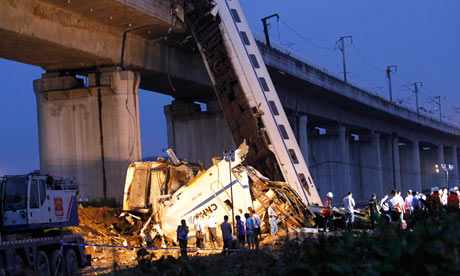
Report says equipment flaws caused Chinese Rail Accident on July, 2011.

Train Wreck in China

China's illegal copying of movies, music, and software cost companies $2.2 billion in 2006 sales, according to an estimate by lobby groups representing Microsoft, Walt Disney (DIS), and Vivendi (VIV.PA).

Environmental degradation:One of the Big questions about China is that although China's economy has grown tenfold since 1978, but what has China's economic boom done to the environment?
The future of China is fraught with a dreadful environmental crisis. Sixteen of the world's twenty most polluted cities are in China. To many, Beijing's pledge to host a "Green Olympics" in the summer of 2008 signaled the country's willingness to address its environmental problems. Experts say the Chinese government has made serious efforts to clean up and achieved many of the bid commitments. However, an environmentally sustainable growth rate remains a serious challenge for the country.
Behind this booming economy lies rampant environmental Pollution

Water pollution and water shortages pose the most serious problems. 
In the Yellow Sea coastline, countless sewage pipes buried in the beach and even extending into the deep sea. April 28, 2008

They cause health ailments, damage agriculture, jam up hydroelectric dams, interfere with manufacturing and limit urbanization. As aquifers dry up, soil erodes, turning an area the size of Connecticut to desert every year. The resulting dust storms add to the country’s already horrendous air pollution. Beijing’s preferred solution to the problem is a massive south-to-north river diversion project. Odds are, that will make matters worse, draining water from already overtaxed southern supplies.
Xuanwei (宣威) in Yunnan province is a cancer village. Every year there are more than 20 people die of cancer. 11-year-old student Xu Li (徐丽) is suffering from bone cancer. May 8, 2007


Corruption: Consider this fact: A recent survey found that of the 20,000 richest men in China, more than 95% were directly related to Communist party officials. One of the major reasons Beijing has such a hard time dealing with all the problems mentioned above is that so many individuals have a vested interest in keeping things exactly as they are. Communist Party officials pay for their advancement, then aim to earn back their investment. Local governments seize houses and land, sell it to developers with little compensation for those displaced, then take kickbacks from the construction companies. Academics provide kickbacks to the party in exchange for research funding. U.S. companies operating in China suffer as well.

"When U.S companies hire for research and development there, there’s a lot of pressure to put Communist Party members in key positions," says Wadhwa.
Officials stand trial in Fujian province in China's biggest corruption scandal

Beijing does make examples of particularly corrupt officials and business leaders, sometimes even executing the offenders. But the problem of corruption is endemic, says Liao Ran, a China specialist with Transparency International. “Generally speaking, the cost of corruption amounts to about 10% to 13% of annual GDP,” he says. In absolute terms, that’s a loss of $500 billion to $700 billion per year.

NO REAL FREEDOM of expression thanks to Vicious Authoritarianism and Draconian form of Administration:

Post-1949 China attracted the world attention in 1989 by the massacre of dissenters in Tiananmen Square.

Citizens of the democratic World are free to declare things that go directly against their Government's credibility (such as, government in their country is not democratically elected or their president is "Hitler-reincarnate"). But in the People’s Republic of China, such an opinion is not within the freedom of speech.

Recently it was announced in the United States that the last still alive eleven participants in the Tiananmen Square protests were shot.

In the democratic West, freedom of speech is a citizen’s legal right.

In the People’s Republic of China, freedom of speech is a bureaucratic permission given by the ruling bureaucracy. Such a bureaucracy ruled thousands of years ago (in China, for example).


China has no rural property rights. China's 750 million rural residents who lease land are at the mercy of the local and regional government as to what compensation they will receive, if any, when they are forced from the land as a result of development, infrastructure improvements, etc. Additionally they have no right to borrow against their lease, and as such they have no assets.
Migrant workers Live like slaves and are bereft of all basic Human-Rights

Wu Chunxia, who was wrongfully imprisoned in a China Henan Provincial Psychiatric Hospital for 132 days as punishment for protesting about local injustice to authorities, says the electric acupuncture needles stung her scalp and the drugs bloated her weight, giving her heart palpitations and brought on premature menopause.
In fact, the Chinese government's official figures state that more than 200,000 hectares of rural land are taken from rural residents every year with little or no compensation. According to some estimates, between 1992 and 2005 20 million farmers were evicted from agriculture due to land acquisition, and between 1996 and 2005 more than 21% of arable land in China has been put to non-agriculture use. China Regime Sends Citizens to Psychiatric Hospitals to Silence Dissent.
China, Henan Province Petitioner ruthlessly Beaten for his dissidence

The result is not unexpected, with over 87,000 mass incidents (or riots) reported in 2005, a 50% increase from 2003. Many provincial governments in China have begun to use ununiformed policemen to beat, intimidate, or otherwise subdue any citizen that dares to oppose the Party.
(Read more about restrictions on freedom in PRC here)

And demographics: 
People in China love to have more children.

The one-child policy is challenged in principle and in practice for violating a basic human right to determine the size of one's own family.
Although, between 2000 and 2005, as many as 1,968 officials in central China's Hunan province were found to be violating the one-child policy by their leverage of affluence, as the generation of the Cultural Revolution retires, the burden of their care falls heavily on the smaller generation of the one-child policy. Thus almost a colossally high 'Dependency Ratio' will affect the economy by reducing cheap labour-power that china boasts now!

“The Chinese population is simply growing older faster than it’s getting richer,”
says Peter Navarro, a professor of economics and public policy at the University of California at Irvine.

As fewer workers support more retirees, competitiveness will suffer. For an illustration of what this could mean, China need look no farther than Japan.


Democracy, no doubt, is a messy thing, especially when you have an electorate that exceeds 600 million people who are motivated to vote. However, democracy also helps to ensure that individual liberties are respected and that the government is responsive and beholden to the will of the people, rich or poor. A democracy also ensures accountability through impartial courts that help enforce and protect such things as property rights, environmental rights, human rights, and good governance.

So, where would you place your bet?

Thursday, January 19, 2012

CHINA’S ECONOMY and GOVERNMENT WILL BE IN SERIOUS TROUBLE WITHIN DECADES


WHY CHINA’S ECONOMY WILL BE DEVASTATED WITHIN DECADES


[China’s economic boom has dazzled investors and captivated the world. But beyond the new high-rises and churning factories lie rampant corruption, vast waste, and the elite with little interest in making things better. Forget political reform. China’s future will be decay, not democracy.]

Since the 1980s, the Chinese government has focused on developing an export-driven economy supported by an artificially undervalued currency. Foreign direct investment was severely encouraged while domestic consumption was limited. Massive infrastructure projects were initiated, fuelled by a growing trade surplus, with cities sprouting up in the hinterlands like some mythical phoenix. For years, the Chinese economy benefited from these policies with double-digit gross domestic product growth, vast foreign currency reserves, and ever increasing capital inflows.

The Fact is, State enterprises are miserably unprofitable. In 2003, a boom year, their median rate of return on assets was a measly 1.5%. More than 35% of state enterprises lose money and 1 in 6 has more debts than assets. China is the only country in history to have simultaneously achieved record economic growth and a record number of non-performing bank loans.

In reality, the only thing rising pertaining to China is the hype about China.

Following is the summarization of basic points as to why Chinese Economic Model is a blatant fiasco.

Well, most of the reasons for China's short-term Economic Growth are also the reasons it is most likely subject to failure.

Their economy is significantly based on EXPORTS, particularly to the west, so if North Americans and Europeans cease to buy shoddy Chinese stuff, China's economy suffers an irrevocable damage.

There are HUGE inequities between the poor and the worker class and the moneyed class in China, there is the old Churchill truism that the “vice of capitalism is the unequal distribution of its benefits and the virtue of socialism is the equitable distribution of its misery.” It's like that. Education, science, infrastructure are all based on the middle 60% of Chinese populace who are still extremely poor when compared to those in other countries (US/EU/Japan).

A small segment of Chinese society (5-10% of the whole) may try and to a degree succeed in achieving something approaching the lifestyle of those in the west, (cars, houses/apartments, office jobs, good education) but there will be a LARGE majority which not only “won't” but could never achieve this lifestyle, they will be pissed off.

Environmental devastation, in the DEVELOPED Countries particularly environmentalism gets short sheet unless something truly tragic happens (Hurricane Katrina, Exxon Valdez , drought, etc) in China, stuff like that happens EVERY DAY, whole river systems have become so toxic, that people get chemically burned by touching the water , let alone drink it or use it for cooking etc. This has gone on for the last 20 years or so. Desertification, water pollution, air pollution, ambient toxicity in the environment (lead/dioxins etc in everything in the environment)

The Environment 2.0 - With global climate change/warming whatever, it may not matter that polar bears go homeless, polar bears don't have nuclear weapons so it doesn't much matter if they are desperate communist party members too.

In China that matters a great deal as you somehow have to keep 1/2 your people fed reasonably consistently (with all the problems mentioned above). Its more than likely you could understandably become somewhat emotionally sensitive to Pakistan or India or someone else laying claim to your water reserves. Wars have begun for less.

Regional conflicts spilling over, Whether it's The Head of the state of North-Korea, Pakistan Chief, some Russian disaffected Generals or Nationalists in Japan or Indonesia there are going to be 4 and potentially as many as 7 nuclear armed states right next door and at least 2 of which (at the least) are not entirely friendly to Chinese interests. This is NOT an entirely happy situation under any circumstances. Any conflict between these states (India/Pakistan) , (Indonesia/Philippines), (Russia & Anybody), would be bad news and invariably involve China.

Straight economics, the Chinese "stock" market is laughably corrupt, a single US citizen with a 401k may have holdings in dozens of companies in a reasonably well diversified portfolio. In China with 1.6 billion people, there are approximately 100 companies traded on their stock-market, more than a few of these are tied to the government somehow, and there is not even a semblance of the accountability that exists in other countries in the EU , US or elsewhere.


Finally, Developed countries’ (esp. USA, German, France) national destinies are linked at the hip with China’s national destiny.

Eventually one of two possibilities will come true with US debt-

A- US citizenry may wake up and demand the government put a 20 year plan or something to retire 80% of the debt.
B- US citizenry does NOT demand the government retire the debt.

Either way , China will be in serious trouble,

“A”, is obviously preferable for all concerned but that's just NOT very likely (This only really hurts China a very little bit).

“B” Is far more likely and will have bad consequences, because China and Japan and most recently India are starting to buy strategically significant amounts of US debt.

The problem is that US politicians currently have an addictive relationship with tax-cuts and debt and they clearly aren't all that serious about actually paying that debt so if the intention to default on that debt became obvious for some reason there could be a RUN on US debt. US citizens would not buy stuff and the economy could be in for a nasty shock. This would ENDANGER China gravely since they've bought so much of US debt, coupled with the exports/trade hit and resurgent concern about US national interest. US would be in danger too but that pain would hurt everyone else along with us.

Alternatively, the thinking is that you can drop an economic "bomb" on the US economy by demanding debt payment or dumping that debt onto the market , either way you bite the hand that feeds and things could get ugly, if the US economy was significantly affected, you would see citizens rioting in the streets to at least appear to get an "A", situation started.

Further Redounding to an already pretty gloomy future of China is a High Dependency Ratio coupled with a very High Sex Ratio. These are bound to cause VERY serious problems for Communist Party of China! Then there are political problems with Tibet and Taiwan!
Age pyramid for China. Each box denotes a five-year age group,
starting with 0-5 years in the bottom box.
Effects of the one-child policy result in smaller age cohorts in recent years.

According to Wang Feng, a professor of Social Development at Fudan University:  
“The consistently low birth rate since the 1990s will cause a noticeable contraction in newly available labor. The section of the population between 20 and 24 years of age will decrease sharply from 125 million in 2010 to just 68 million in 2020 – a 50% decline in only 10 years.”

Further Truth about Chinese innovation and Collapse

Chinese innovation is under question:


As an expatriate living in Hong Kong for nearly 30 years, Wendy Nesbitt is very familiar with counterfeit goods produced in China and sold on the Hong Kong black market for bottom basement prices. Products range from suits to jewelry and are easily available. One of the most copied industries is that of women’s handbags.

In small markets, store vendors show a wide variety of imitation purses in the front of their shops. The handbags are not marked with brand names but have similar designs to designer bags of the current season. The bags here sell for roughly 5-10% of what the real bags would sell for in the United States.
However, the most blatant fake product offences are not on display.

The simple underlying motives and the government interactions that formed this underground handbag market in Hong Kong are representative of the conditions that surround most of the fake product manufacturing and technology theft in China.

In this era where "Innovation" is what the whole world is striving for, many Chinese commentators said that once a good thing is implemented in China, it inevitably becomes incredibly abnormal. To what extent is China's innovation independent?

Despite People's Republic China (PRC) being a member of 'World Intellectual Property Organization', typical thinking of Chinese leaders goes something like the following:

“Our technologies may[what's the doubt about?] originate from foreign countries, but it doesn’t mean that what we have now all belongs to them,” said Ma Yunshuang [deputy director with the technical center of China Southern Locomotive and Rolling Stock Industry (Group) Corporation.]
They can't even comprehend the idea behind Intellectual property rights.


On October 9, 2010, it was reported that Meizu had shut down production of the M8 due to pressure from the Intellectual Property Offices and Apple Inc. because of its blatant similarities to the iPhone.


The truth is this almost imperial country now-a-days doesn't even possess a brand that is well-renowned for its Innovation.
"China's independently developed high-speed rail technology has significantly surpassed Japan's."
"There's no doubt with China's high-speed rail safety; there will never occur a rear-end crash."

—While these type of lofty grandiloquence of the Chinese officials and experts of Ministry of Railways are still ringing in people's ears, there occurred the Wenzhou train crash on July 23. The accident caused hundreds of casualties(at least 38 people dead and 192 injured).


The costly innovation by the Communist Party (CCP) is so unrealistic and incongruous that it puzzles railway experts around the world. The technology that can automatically prevent crashes is very mature in Japan and in Europe and even if the train driver sleeps on the train, there would be no train crash from the rear. But the accident did happen in China. And the reason behind this incident, that is shameful for a country that boasts ostentatiously about its technological advancements, is train control system innovated domestically by the CCP, as a "prestige project." 
The train crash in China's Zhejiang province on July 23, 2011
 According to BBC China bullet train crash was 'caused by design flaws'. And Also Chinese educational is way below par for the course. (click here for more info about CCP(Chinese communist party)'s presumably ghastly  and entirely baleful issues).


Aftermath of the Train Crash:                                                                                                                 


BEIJING — After days of growing public fury over last month’s high-speed train crash and the government’s reaction, Chinese Dictators have enacted a virtual news blackout on the disaster except for positive stories or information officially released by the government. (This the extent of freedom offered in Mainland China)
Nevertheless, that devastating accident didn't seem to worry Spokesman Wang Yongping who claimed:
 "China's high-speed rail technology is up to date and up to standard [for quick reduction of the population?], and we still have faith in it." (LIE)
Despite reported directives from the "Propaganda Department" (effectively muzzles any critical view against the party and spreading propaganda and even meta-propaganda), Chinese media, both independent and state-owned, directly criticized the Ministry of Railways and voiced their skepticism of the government.

In one instance, in response to Wang Yongping's assurance at the press conference that the Chinese railway system was running on "advanced technology", news anchor Bai Yansong retorted on CCTV
"The technology may be advanced, but is your management advanced? Are your standard operating procedures advanced? Is the Supervision advanced? Is your respect for people advanced? Are all the minute details advanced? At the end of the day, is your overall operational capability advanced?"
Such challenges to officially-sanctioned orthodoxy were actually bold and extremely rare, particularly on programs aired on China's state-owned television. (Why do we say that? Click here and here)
Internet users attacked the government's response to the disaster after authorities muzzled media coverage and commanded reporters to focus on rescue efforts.

(Chinese Communist Party doesn't care about people's rights any more than, say, frogs do)

Most of China's current high-speed railways use the technologies of Japan, Germany and Canada, among which most are imported from Japan.
But this is never mentioned in public. Japan's 'Sankei Shimbunm' calls China's shoddy high-speed rails as "pirated versions of the Shinkansen." (nothing more than a shoddy imitation!)
The media of various countries reported that the majority of China's high-speed rail technologies were mostly stolen from Japan, in the name of project collaboration. Thus their inefficiency and lack of prowess.

Japanese bullet train: Kawasaki Heavy Industries Ltd. threatened to sue if China attempted to obtain patents for technology originally developed in Japan

The Australian quoted Japanese high-speed rail experts that after collaborating on early projects, China stole Japan's technology and froze the experts out, as it looked to establish a vast domestic network as well as an export industry in high-speed rail.
Japan's media Asahi Shimbun's reported on July 5 that Tadaharu Ohashi, president of Kawasaki Heavy Industries said that
"If the content of the overseas tenet application of China's high-speed railway contravenes the Shinkansen technology export contract signed by China and Kawasaki Heavy Industries. They will have to sue China."
Current issue commentator Wu Fan:
"China actually has no innovation, because of China's current social system and the people's state of mind, especially that the government takes the lead to steal foreign assets and intellectual properties in particular."

In spite of urban China’s modern veneer, there’s still a deeply rooted cultural component at work. The whole idea of copyright is simply foreign.” Seattle Times, February 12, 2006

Complaints about China's stealing of technology under color of cooperation not only came from Japan, but also from Russia and even USA.
Russia's newspaper 'Pravda' published in April 2009 article :
"China Brazenly Steals Russian Jet Fighter Technology."
Current Issue Commentator Heng He: Such copycat is governmental behavior.
Except China's jet fighter "Jian" series, the rest are all imitations of the Russian system. Even if they are by China's own design, their motors are still made in Russia.

TIMOTHY GEITHNER: CHINA ‘VERY, VERY AGGRESSIVE’ IN STEALING U.S. TECHNOLOGY. Treasury Secretary Timothy Geithner said on Thursday that China is holding to its decades-old strategy to steal American intellectual property, in a pointed statement reflecting U.S. officials’ growing impatience with Beijing.

“They China have made possible systematic stealing of intellectual property of American companies and have not been very aggressive to put in place the basic protections for property rights that every serious economy needs over time,”  Geithner told a forum in Washington. 

"Tell your Congressmen and Our President that when China honors International Copyright Law and pays back the Billions its stolen from the US, then the US will continue to repay China its debt." – Carlo Capomazza


GM, Fords, etc sued Chinese Automotive Companies for stealing their design.

Facing questions from foreign companies and media, how many absolutely independent innovations does China have? Why this imperialistic country now doesn't possess even one world-renowned brand providing "Unique Innovation"?
Heng He:
"This is related to China's development model. In the past 30 years, the CCP's[Communist Party of China] model is GDP-oriented. It only wanted to accelerate the development speed. However, it didn't have an integral system designed for long term or a system that follows economic patterns. This is why China's total economic output has become the world's No.2 but still without a world-class brand."

Heng He said that bulk purchase of foreign technologies enables the officials to get rebates. This contributes to the failure in development of China's independent innovations.

Anil Gupta, professor of Strategy & Entrepreneurship,University of Maryland and Haiyan Wang, managing partner of China India Institute, wrote an article published on Wall Street Journal on July 28. The article says in China,
  1. processes for allocating government funds for R&D projects remain highly politicized. Research heavily focuses on quantity over quality.
  2. They use local rather than international standards to assess research productivity. 
  3. Academic frauds are rampant.
  4. The educational structure emphasizes on rote learning rather than creative problem solving. 
Due to these reasons, although having lots of researchers, and abundant funds, China's innovations are still stymied.

For years the Chinese government neglected the counterfeit problem entirely. However, deaths caused by fake pharmaceuticals and baby formula as well as the copying of China’s own brands has caused the government to place increased importance on intellectual property laws. With China’s entry into the World Trade Organization, other countries have also put pressure on China to prosecute offenders with some success.
 

Communist China's (immanent) Economic Collapse:

On January 3, 2011 in New Year's message to business, Premier Wen Jiabao warned: "The first quarter can be quite difficult." (it's rhetorical allusion to a complete collapse)

Many of the so-called "economic contribution" phenomena, which the Chinese Communist Party (CCP) is dependent on, have begun to vanish. The CCP's safety net begins to fracture too.

Last October, Prof. Lang Xianping at the Chinese University of Hong Kong, talked in Shenyang about the economy. He pointed out during his speech, that China's economy is virtually bankrupt, but this cannot go in the official books. Prof. Lang said that China's Purchasing Manager Index shows, that China has entered recession as early as July 2011. However, all CCP's policies are such that they can cover up the real ailing situation.

Prof. Lang pointed out during his speech in Shenyang, that 70% of China's GDP is from infrastructure development. However, these are not cost-effective. Plus, the real pillar of China's economy, manufacturing, is now in a crisis too. He pointed out that many industries in Jiangsu and Zhejiang, have only 30% to 60% operating rate.

As the industry is sluggish, China's manufacturing industry is facing closures and strikes. Since 2008, in Dongguan, the Pearl River Delta, Wenzhou, Yangtze River Delta, etc., many businesses have closed down. In Wenzhou alone, from April to October, 2010, over 80 heavily indebted businessmen fled or committed suicides.

Chen Zhifei, economics' professor at New York City Univ., pointed out that China's private businesses have a hard time. Prof. Chen thinks this is due to CCP's preferential policies to state-owned enterprises and discrimination of private SMEs.

Prof. Chen:
"During the economy depression since 2008, (CCP) vigorously supported the state-owned enterprises. Although most of them were in deficit or bankruptcy state, they (CCP) still put money into these industries, as to support their own, private and monopoly party assets. Regarding the majority of the small and medium enterprises, the CCP suppressed them, and has policies of discrimination and restrictions on financial assistance."

In the first week of 2012, another round of the strikes' wave has launched in China. Sichuan, Guangxi, and Jiangsu had three strikes a day, each with thousands of people participating. Last year and the year before, large-scale strikes took place in many provinces and cities. These include Guangdong, Beijing, Shanghai, Jiangsu, Gansu, Chongqing, etc., or wherever there was a plant, was a strike.

Prof. Chen said, for a long time CCP is using cheap labor to attract foreign investments, playing a disgraceful role.

Prof. Chen:
"The Chinese government and the authorities, and the CCP system as a whole, play a very shameful role. They are pushing the Chinese people into the fire pit, using monopolized capital and cheap labor, acting as an evil boss."

Now oppression policies rebound, and prices rise fast, the labor force demands higher wages and went on strikes. The changes cause foreign manufacturers to retreat.

Morgan Stanley data shows that over the past 10 years, Chinese workers' salary grew nearly 12% per year. As the costs increase rapidly, many companies have begun to withdraw from China.