Showing posts with label hatred. Show all posts

Sunday, February 05, 2012

CONTEMPORARY CHINA'S MIRROR IMAGE: IMPERIAL GERMANY


Original article by KirkRogers 04/25/2010 

China has emerged as the bad boy on the global scene, pushing around executives at Rio Tinto, attacking Google, and humiliating Barack Obama at the Copenhagen Climate Talks. Speculation is growing about China’s rising power and the country’s leaders are displaying a discouraging sense of hubris. There is growing fear that the autocratic Middle Kingdom will soon dominate the world. 

These fears have parallels with another rising power of a century ago: Imperial Germany. Both emerged quickly on the global scene and did so with an enormous chip on their shoulders. Like China today, Germany was a little late coming to the industrial revolution, though its cultural contribution to European civilization and in turn to American civilization was enormous (Ralph Waldo Emerson was passionate student of Goethe). Only after its final unification and triumph over the French in the Franco-Prussian War of 1871 could Otto von Bismarck, the great 19th century pragmatist, force Germany’s sundry states into union. 

Again like China, once united and in control of its own destiny, Germany grew quickly, harboring ever more delusions about its place in the sun. In the years leading to the First World War Wilhelm I, the competent Bismarck confidant, died of cancer. This allowed vainglorious Wilhelm II to assume the mantle of the state in 1888. Prussian militarism by then was backed by a massive industrial machine operating in complete fealty to the state. Germany’s new Emperor and his clique felt that it had something to prove. 

China, once the most advanced nation on earth, similarly has a passel of historical resentments ranging from the Opium War to the complete denigration of its standing in the world. Like Germany, China has viewed itself as an advanced culture whose time had now arrived. Like Germany in the late 19th Century, it has incorporated technologies from others about as fast as it could get its hands on them. 

When Deng Zhao Ping awoke China from its Maoist/Stalinist nightmare that ripped through the country under the guise of the Cultural Revolution, they were confronted with the disintegration of communist governments around the world. Chinese leaders knew that the only way to for them to hold power was to have their economy grow. This approach parallels the economic pragmatism in late Imperial Germany under Bismarck and the Hohenzollerns, who pushed economic growth as a means of promoting social welfare while simultaneously doing all they can to consolidate power in their hands. Bismarck created the first social security system not out of a deep seated concern for the proletariat but to emasculate the socialist party. 

China by the same token has not adopted capitalism because they want to move the country towards rule of law and greater democracy but as a means of justifying their continued presence at the country’s helm. China, much like Imperial Germany, has witnessed unbelievable growth because of these centralized policies

On the eve of WWI, Germany was the second largest economy in the world after shooting ahead of Britain and trailing America. China just accomplished a similar feat in an even shorter time frame. China passed contemporary Germany a couple of years ago and is poised to do so with Japan in the coming year. China is cultivating a modern-style imperial presence in Iran, Africa and Latin America in an effort to secure the natural resources that the country lacks much like Germany did. Ironically, China is doing more to raise living standards in Africa than any western aid program has been able to do. 


German industrial bosses were elites, most bore the titles of nobility. China’s bosses have been compared to the Emperor’s corrupt courtesans. The vast wealth of the Thyssen and Krupp steel dynasties can still be seen today in the massive industrial museums lining the Ruhr Valley. As in Imperial Germany, the military dominates large swaths of the economy. Germany in the late 19th and early twentieth century used its coal and iron resources to build the munitions factories that lined the despoiled Ruhr and Rhine. Holding even tighter on the reigns, China has developed an a strong state-dominated economy, forcing, for example, foreign firms to enter a joint venture with a state-owned corporation, which will quickly steal what it can of the western company’s intellectual property. 

The two governments bear disturbing similarities. Germany also had a vast bureaucracy attempting to tamp down any sedition amongst its masses. China is doing much the same. The most interesting parallel however is the rampant nationalism propagated in both Imperial Germany then and contemporary China. 

Of course, there are also some significant differences. China, for example, is much larger than Germany ever was. China is also not necessarily as instinctively expansionist . But it is extremely sensitive when it comes to Taiwan. The kerfuffle over arms sales to Taiwan last month provides more than enough evidence of this. Germany also had territories that it got very sensitive about as well. China’s attitude towards Taiwan and Tibet echoes the Kaiser’s sentiment towards occupying Strasbourg along the French border. 

Is China going to attack its neighbors and plunge the Pacific Rim into World War Three? It seems highly unlikely. China still has a lot of growing left to do. Large swaths of the peasantry are still stumbling along at poverty levels. China is also well aware of the US military’s ability to project force should it try to attack Taiwan. 

China may want to occupy Taiwan and there is none of the rhetoric among the leadership cadre about the need for Lebensraum that dominated conversations in German salons before the Great War. China’s leadership also appears far more competent than that of late Imperial Germany. But this may have to do with dumb luck. The Hohenzollerns up until Wilhelm II were all competent leaders. Could China be so unlucky as well? Could one idiot weasel his way up through the CP ranks? Who knows? 

China has serious problems with restive minorities and a growingly arrogant and repressive regime. It has industrial might, a massive resentment of western powers and a desire to get its own place in the sun. It does not have the same geographical pressures that Germany had and it is still not in any position to take on the US in the military theater and its rulers realize that. Though its economy is inflating, much of the population living below the poverty line. 

So far the technocrats over the last thirty years have been freakishly capable and have generally done a good job. The real trial of China’s claim to its place in the sun will be when a blustering fool like Kaiser Wilhelm weasels his way into the party chairmanship. Just as Germany was powerless to dispose of its ill-suited leader, China may very well be as well. If that happens, God help us all. 

Saturday, February 04, 2012

Excerpts of "The Black Book of Communism"


Pertinent quotes from the best-selling book 
[by several European academics and edited by Stéphane Courtois]

“To be sure, the [communistic] model was applied differently in different cultural settings. As Margolin points out, the chief agent of repression in Russia was a specially created political police, the Cheka-GPU-NKVD-KGB, while in China it was the People's Liberation Army, and in Cambodia it was gun-toting adolescents from the countryside: thus popular ideological mobilization went deeper in Asia than in Russia.

Still, everywhere the aim was to repress "enemies of the people" — "like noxious insects," as Lenin said early on, thus inaugurating Communism's "animalization" of its adversaries. Moreover, the line of inheritance from Stalin, to Mao, to Ho, to  Kim II Sung, to Pol Pot was quite clear, with each new leader receiving both material aid and ideological inspiration from his predecessor.

[Editor Stéphane Courtois asserts that "...Communist regimes...turned mass crime into a full-blown system of government". He cites a death toll which totals 94 million, not counting the "excess deaths"

(decrease of the population due to lower than-expected birth rates). Deaths given by Courtois is as follows]

It is not always easy to distinguish between events caused by fighting between rulers and rebels and events that can properly be described only as a massacre of the civilian population. Nonetheless, we have to start somewhere. The following rough approximation, based on unofficial estimates, gives some sense of the scale and gravity of these crimes: 


Deaths due to Communism
Country NameNumber of Deaths
U.S.S.R.20 million
China65 million
Vietnam1 million
North Korea2 million
Cambodia2 million
Eastern Europe1 million
Latin America150,000
Africa1.7 million
Afghanistan1.5 million

The international Communist movement and Communist parties not in power: about 10,000 deaths.
The total approaches 100 million people killed.

The immense number of deaths conceals some wide disparities according to context. Unquestionably, if we approach these figures in terms of relative weight, first place goes to Cambodia, where Pol Pot, in three and a half years, engaged in the most atrocious slaughter, through torture and widespread famine, of about one-fourth of the country's total population.

However, China's experience under Mao is unprecedented in terms of the sheer number of people who lost their lives. As for the Soviet Union of Lenin and Stalin, the blood turns cold at its venture into planned, logical, and "politically correct" mass slaughter.

“And the less familiar figures in Margolin's chapter in "China: A Long March into Night" are even more staggering: at a minimum, 10 million "direct victims"; probably 20 million deaths out of the multitudes that passed through China's "hidden Gulag," the laogai; more than 20 million deaths from the "political famine" of the Great Leap Forward of 1959-1961, the largest famine in history.”

“During Mao's Cultural Revolution, priceless treasures were smashed or burned by the Red Guards. Yet however terrible this destruction may ultimately prove for the nations in question and for humanity as a whole, how does it compare with the mass murder of human beings — of men, women, and children?”

"The book's second point is that there never was a benign, initial phase of Communism before some mythical "wrong turn" threw it off track."


[The Black Book of Communism received praise in a number of publications in the United States and Britain, including the Times Literary Supplement, New York Times Book Review, Library Journal, Kirkus Reviews, The New Republic, National Review and The Weekly Standard   ]

Saturday, January 21, 2012

China's Imminent Economic Crisis Startles Economists

China Starts to feel the HEAT of an Economic Meltdown
Beijing's National Bureau of Statistics revealed China's GDP growth in the fourth quarter slowed to 8.9% from 9.2% in 2011.
 
Reuters and Associated Press believe China's economic growth this year is still falling, but is expected to have a "soft landing."
 
Other media and academics are worried that China's economy this year may actually experience a "hard landing."

On January 17, at the State Council Information Office press conference, Chief of Bureau of Statistics, Ma Jiantang spoke about China's GDP growth. Ma said, despite its decrease in 2011, GDP growth was largely in line with macro-control goals.

Ma Jiantang commented that 2011's global financial crisis should invite concerns about 2012's economic development.

Chen Zhifei, Professor of Economics from City University of New York, said, the Chinese Communist Party (CCP) always reports the good rather than the bad news. Ma Jiantang's remarks are actually a reminder of the severity of the situation.

Chen Zhifei: 
"There is a trend of decline in China's economy now. The surface fixes and false data can't be hidden any more. Overall, the conclusion is that China's economy is still in a very grim situation, which is indeed worrying."

On January 18, the Ministry of Commerce announced that China's 2011 European and American investments declined.
US investments decreased 26.07%. Pittance Investments from the EU decreased 3.65%.

On January 12, The Guardian cited Albert Edwards (Head of economic strategy from the French bank "Societe Generale"). His analysis showed, China is likely to face a "hard landing" (
that is just a prelude to TOTAL COLLAPSE) in 2012 which will lead to the global economic crisis' climax. Edwards warned that the Chinese economy expended with about 10% average annual growth over the past 20 years. But with the two touches of the economic bottom in the West and China's overheated real estate market, China's economy may face serious problem in the future.

Chen Zhifei:
"With the further deepening debt crisis in Europe this year, China's economy will encounter greater challenges. From a domestic perspective, the real estate bubble and overall decline of manufacturing industries, as well as other aspects promoting economic development, will make the CCP unable to do anything. Plus the inflation, they all make a cycle, which China's economy cannot jump out of."

Bureau of Statistics' latest figures show that China's urban population reached 51.3%, exceeding the rural population,
This is for the first time in China's history.
Ma Jiantang believes that changes in population structure will play a positive role in promoting domestic demand. He does not think that local debt and real estate are the largest risks of China's economic performance.

Beijing economist, Feng Xingyuan, said that China's GDP is still dominated by the government's investment and administration (or rather, draconian oppression), which runs counter to the market economy.

In the first half of 2012, real estate may experience a major reshuffle. Private investments unable to withstand restriction measures will quit.

Feng Xingyuan:
"Last year, the restriction measures affected the overall size and growth rate of GDP. The growth rate is kept in the way of national development and people's regression. For example, the development of protection housing is in fact a form of increasing government investment to maintain GDP."

According to the released GDP from Bureau of Statistics, in 2011, China's GDP per capita is 5,000 dollars. Sun Lijian, Vice President of Economics at Fudan University believes, GDP per capita is still questionable, and can have a downward trend. Cai Zhizhou, Research Center of National Accounts from Peking University pointed out that in 2010, China's GDP per capita ranked 95th in the world.

And that China's last year figure was almost the same as that of Namibia, Africa, for 2010. Germany's Der Spiegel commented that for China, this is almost a critical value. The growing wealthy class needs to share the success with lower income class, otherwise, it will be difficult to avoid a great social upheaval.

Thursday, January 19, 2012

Further Truth about Chinese innovation and Collapse

Chinese innovation is under question:


As an expatriate living in Hong Kong for nearly 30 years, Wendy Nesbitt is very familiar with counterfeit goods produced in China and sold on the Hong Kong black market for bottom basement prices. Products range from suits to jewelry and are easily available. One of the most copied industries is that of women’s handbags.

In small markets, store vendors show a wide variety of imitation purses in the front of their shops. The handbags are not marked with brand names but have similar designs to designer bags of the current season. The bags here sell for roughly 5-10% of what the real bags would sell for in the United States.
However, the most blatant fake product offences are not on display.

The simple underlying motives and the government interactions that formed this underground handbag market in Hong Kong are representative of the conditions that surround most of the fake product manufacturing and technology theft in China.

In this era where "Innovation" is what the whole world is striving for, many Chinese commentators said that once a good thing is implemented in China, it inevitably becomes incredibly abnormal. To what extent is China's innovation independent?

Despite People's Republic China (PRC) being a member of 'World Intellectual Property Organization', typical thinking of Chinese leaders goes something like the following:

“Our technologies may[what's the doubt about?] originate from foreign countries, but it doesn’t mean that what we have now all belongs to them,” said Ma Yunshuang [deputy director with the technical center of China Southern Locomotive and Rolling Stock Industry (Group) Corporation.]
They can't even comprehend the idea behind Intellectual property rights.


On October 9, 2010, it was reported that Meizu had shut down production of the M8 due to pressure from the Intellectual Property Offices and Apple Inc. because of its blatant similarities to the iPhone.


The truth is this almost imperial country now-a-days doesn't even possess a brand that is well-renowned for its Innovation.
"China's independently developed high-speed rail technology has significantly surpassed Japan's."
"There's no doubt with China's high-speed rail safety; there will never occur a rear-end crash."

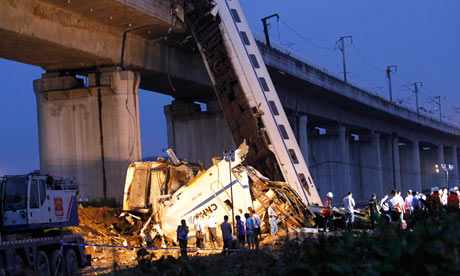
—While these type of lofty grandiloquence of the Chinese officials and experts of Ministry of Railways are still ringing in people's ears, there occurred the Wenzhou train crash on July 23. The accident caused hundreds of casualties(at least 38 people dead and 192 injured).


The costly innovation by the Communist Party (CCP) is so unrealistic and incongruous that it puzzles railway experts around the world. The technology that can automatically prevent crashes is very mature in Japan and in Europe and even if the train driver sleeps on the train, there would be no train crash from the rear. But the accident did happen in China. And the reason behind this incident, that is shameful for a country that boasts ostentatiously about its technological advancements, is train control system innovated domestically by the CCP, as a "prestige project." 
The train crash in China's Zhejiang province on July 23, 2011
 According to BBC China bullet train crash was 'caused by design flaws'. And Also Chinese educational is way below par for the course. (click here for more info about CCP(Chinese communist party)'s presumably ghastly  and entirely baleful issues).


Aftermath of the Train Crash:                                                                                                                 


BEIJING — After days of growing public fury over last month’s high-speed train crash and the government’s reaction, Chinese Dictators have enacted a virtual news blackout on the disaster except for positive stories or information officially released by the government. (This the extent of freedom offered in Mainland China)
Nevertheless, that devastating accident didn't seem to worry Spokesman Wang Yongping who claimed:
 "China's high-speed rail technology is up to date and up to standard [for quick reduction of the population?], and we still have faith in it." (LIE)
Despite reported directives from the "Propaganda Department" (effectively muzzles any critical view against the party and spreading propaganda and even meta-propaganda), Chinese media, both independent and state-owned, directly criticized the Ministry of Railways and voiced their skepticism of the government.

In one instance, in response to Wang Yongping's assurance at the press conference that the Chinese railway system was running on "advanced technology", news anchor Bai Yansong retorted on CCTV
"The technology may be advanced, but is your management advanced? Are your standard operating procedures advanced? Is the Supervision advanced? Is your respect for people advanced? Are all the minute details advanced? At the end of the day, is your overall operational capability advanced?"
Such challenges to officially-sanctioned orthodoxy were actually bold and extremely rare, particularly on programs aired on China's state-owned television. (Why do we say that? Click here and here)
Internet users attacked the government's response to the disaster after authorities muzzled media coverage and commanded reporters to focus on rescue efforts.

(Chinese Communist Party doesn't care about people's rights any more than, say, frogs do)

Most of China's current high-speed railways use the technologies of Japan, Germany and Canada, among which most are imported from Japan.
But this is never mentioned in public. Japan's 'Sankei Shimbunm' calls China's shoddy high-speed rails as "pirated versions of the Shinkansen." (nothing more than a shoddy imitation!)
The media of various countries reported that the majority of China's high-speed rail technologies were mostly stolen from Japan, in the name of project collaboration. Thus their inefficiency and lack of prowess.

Japanese bullet train: Kawasaki Heavy Industries Ltd. threatened to sue if China attempted to obtain patents for technology originally developed in Japan

The Australian quoted Japanese high-speed rail experts that after collaborating on early projects, China stole Japan's technology and froze the experts out, as it looked to establish a vast domestic network as well as an export industry in high-speed rail.
Japan's media Asahi Shimbun's reported on July 5 that Tadaharu Ohashi, president of Kawasaki Heavy Industries said that
"If the content of the overseas tenet application of China's high-speed railway contravenes the Shinkansen technology export contract signed by China and Kawasaki Heavy Industries. They will have to sue China."
Current issue commentator Wu Fan:
"China actually has no innovation, because of China's current social system and the people's state of mind, especially that the government takes the lead to steal foreign assets and intellectual properties in particular."

In spite of urban China’s modern veneer, there’s still a deeply rooted cultural component at work. The whole idea of copyright is simply foreign.” Seattle Times, February 12, 2006

Complaints about China's stealing of technology under color of cooperation not only came from Japan, but also from Russia and even USA.
Russia's newspaper 'Pravda' published in April 2009 article :
"China Brazenly Steals Russian Jet Fighter Technology."
Current Issue Commentator Heng He: Such copycat is governmental behavior.
Except China's jet fighter "Jian" series, the rest are all imitations of the Russian system. Even if they are by China's own design, their motors are still made in Russia.

TIMOTHY GEITHNER: CHINA ‘VERY, VERY AGGRESSIVE’ IN STEALING U.S. TECHNOLOGY. Treasury Secretary Timothy Geithner said on Thursday that China is holding to its decades-old strategy to steal American intellectual property, in a pointed statement reflecting U.S. officials’ growing impatience with Beijing.

“They China have made possible systematic stealing of intellectual property of American companies and have not been very aggressive to put in place the basic protections for property rights that every serious economy needs over time,”  Geithner told a forum in Washington. 

"Tell your Congressmen and Our President that when China honors International Copyright Law and pays back the Billions its stolen from the US, then the US will continue to repay China its debt." – Carlo Capomazza


GM, Fords, etc sued Chinese Automotive Companies for stealing their design.

Facing questions from foreign companies and media, how many absolutely independent innovations does China have? Why this imperialistic country now doesn't possess even one world-renowned brand providing "Unique Innovation"?
Heng He:
"This is related to China's development model. In the past 30 years, the CCP's[Communist Party of China] model is GDP-oriented. It only wanted to accelerate the development speed. However, it didn't have an integral system designed for long term or a system that follows economic patterns. This is why China's total economic output has become the world's No.2 but still without a world-class brand."

Heng He said that bulk purchase of foreign technologies enables the officials to get rebates. This contributes to the failure in development of China's independent innovations.

Anil Gupta, professor of Strategy & Entrepreneurship,University of Maryland and Haiyan Wang, managing partner of China India Institute, wrote an article published on Wall Street Journal on July 28. The article says in China,
  1. processes for allocating government funds for R&D projects remain highly politicized. Research heavily focuses on quantity over quality.
  2. They use local rather than international standards to assess research productivity. 
  3. Academic frauds are rampant.
  4. The educational structure emphasizes on rote learning rather than creative problem solving. 
Due to these reasons, although having lots of researchers, and abundant funds, China's innovations are still stymied.

For years the Chinese government neglected the counterfeit problem entirely. However, deaths caused by fake pharmaceuticals and baby formula as well as the copying of China’s own brands has caused the government to place increased importance on intellectual property laws. With China’s entry into the World Trade Organization, other countries have also put pressure on China to prosecute offenders with some success.
 

Communist China's (immanent) Economic Collapse:

On January 3, 2011 in New Year's message to business, Premier Wen Jiabao warned: "The first quarter can be quite difficult." (it's rhetorical allusion to a complete collapse)

Many of the so-called "economic contribution" phenomena, which the Chinese Communist Party (CCP) is dependent on, have begun to vanish. The CCP's safety net begins to fracture too.

Last October, Prof. Lang Xianping at the Chinese University of Hong Kong, talked in Shenyang about the economy. He pointed out during his speech, that China's economy is virtually bankrupt, but this cannot go in the official books. Prof. Lang said that China's Purchasing Manager Index shows, that China has entered recession as early as July 2011. However, all CCP's policies are such that they can cover up the real ailing situation.

Prof. Lang pointed out during his speech in Shenyang, that 70% of China's GDP is from infrastructure development. However, these are not cost-effective. Plus, the real pillar of China's economy, manufacturing, is now in a crisis too. He pointed out that many industries in Jiangsu and Zhejiang, have only 30% to 60% operating rate.

As the industry is sluggish, China's manufacturing industry is facing closures and strikes. Since 2008, in Dongguan, the Pearl River Delta, Wenzhou, Yangtze River Delta, etc., many businesses have closed down. In Wenzhou alone, from April to October, 2010, over 80 heavily indebted businessmen fled or committed suicides.

Chen Zhifei, economics' professor at New York City Univ., pointed out that China's private businesses have a hard time. Prof. Chen thinks this is due to CCP's preferential policies to state-owned enterprises and discrimination of private SMEs.

Prof. Chen:
"During the economy depression since 2008, (CCP) vigorously supported the state-owned enterprises. Although most of them were in deficit or bankruptcy state, they (CCP) still put money into these industries, as to support their own, private and monopoly party assets. Regarding the majority of the small and medium enterprises, the CCP suppressed them, and has policies of discrimination and restrictions on financial assistance."

In the first week of 2012, another round of the strikes' wave has launched in China. Sichuan, Guangxi, and Jiangsu had three strikes a day, each with thousands of people participating. Last year and the year before, large-scale strikes took place in many provinces and cities. These include Guangdong, Beijing, Shanghai, Jiangsu, Gansu, Chongqing, etc., or wherever there was a plant, was a strike.

Prof. Chen said, for a long time CCP is using cheap labor to attract foreign investments, playing a disgraceful role.

Prof. Chen:
"The Chinese government and the authorities, and the CCP system as a whole, play a very shameful role. They are pushing the Chinese people into the fire pit, using monopolized capital and cheap labor, acting as an evil boss."

Now oppression policies rebound, and prices rise fast, the labor force demands higher wages and went on strikes. The changes cause foreign manufacturers to retreat.

Morgan Stanley data shows that over the past 10 years, Chinese workers' salary grew nearly 12% per year. As the costs increase rapidly, many companies have begun to withdraw from China.